If you’ve ever walked past a fire department’s maintenance bay, or helped a local volunteer crew restock gear after a training drill, you know lined fire hoses aren’t just thick rubber tubes—they’re a fire team’s lifeline. For nearly a decade, I’ve run a specialty supplier focused exclusively on lined fire hoses, so I’ve seen firsthand how a hose that works today can fail tomorrow. It’s not just old age, either. Most people think hose failure boils down to “it’s been around too long,” but after working with fire departments across three states, testing hundreds of returned hoses, and walking crews through post-incident debriefs, I can tell you: failure is almost always a predictable, preventable chain of events. Let’s break down exactly what causes lined fire hoses to fail, and what every fire team should watch for. Lined Fire Hoses
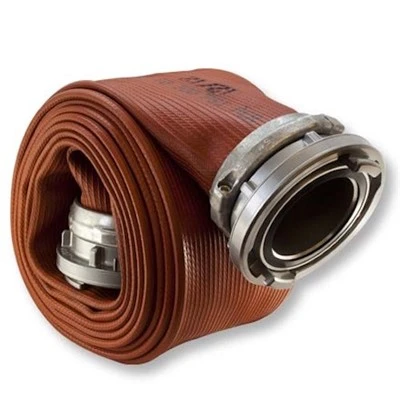
First, let’s get clear on the basics: lined fire hoses have two core parts that make them functional. The outer jacket is typically woven from heavy-duty synthetic fabric—usually polyester or nylon—designed to hold shape, resist abrasion, and protect the inner liner. The inner liner is what does the real heavy lifting: it’s made of materials like EPDM (ethylene propylene diene monomer rubber), silicone, or PVC, and its job is to hold pressurized water without leaking, while also being flexible enough to drag through debris, around corners, and over sharp curbs. When either part breaks down, you get a failure—whether that’s a slow seep, a catastrophic burst mid-discharge, or a kink that collapses the liner entirely.
The most common failure I see isn’t the dramatic burst everyone imagines. It’s liner degradation from chemical exposure, and it’s way more insidious. Firefighting sites are full of chemicals that eat away at liners before you even see a problem. Let’s talk about these: when you’re putting out a structure fire, you’re dealing with things like burned plastic foam, paint solvents, gasoline spills, and fire retardant chemicals that departments spray on hot spots to keep fires from spreading. Even something as common as a chlorinated water supply, which many municipal fire departments use in their permanent pump systems, can break down certain liner materials over time. Last year, we processed a set of 1,000-foot 1.5-inch hoses returned from a suburban volunteer department; their liners had developed tiny, invisible cracks that only showed up when we pumped them under pressure. The issue? They’d been stored near a maintenance bay where the crew disposed of spent cleaning solvents for gear, and fumes from those solvents seeped into the unrolled hoses stacked against the wall. Over six months, those fumes ate at the liner’s molecular structure, turning it from flexible to brittle. When the crew pulled the hoses for a night call, one burst at the coupling, spraying 300 gallons of water into the street and leaving them without a line for 20 minutes. That’s avoidable, right? If they’d stored the hoses away from chemical fumes, that wouldn’t have happened.
Another chemical culprit I see frequently is diesel exhaust. A lot of departments park their fire trucks in bays right next to generator sets or pump trailers that run on diesel. When those generators are idling, diesel fumes can drift through the bay and settle into stacked, unrolled hoses. For EPDM liners—one of the most common we supply—diesel’s hydrocarbons break down the liner’s polymer chains, leading to what’s called “liner delamination.” That’s when the liner separates from the outer jacket. You might not notice it at first; it looks like the hose is fine. But once delamination starts, the liner can bulge under pressure, twist, or even tear free from the coupling. We had a rural department come to us after a barn fire where three of their hoses collapsed entirely mid-stream during a hay bale fire. Their generator had run 12 hours a day, every day, in the same bay as their hose stack, and the delamination had progressed so far that the liner folded in on itself when pressure hit.
Next up: mechanical damage from improper handling. Lined hoses are tough, but they’re not indestructible. The number one mechanical damage cause I see is dragging hoses over sharp edges, and not just during fires. Many crews drag hoses to their trucks during training drills, or leave them rolled up on gravel lots for weeks at a time. When you drag a hose over a sharp curb, a metal fence post, or even a broken glass bottle from a roadside trash dump, you don’t just nick the outer jacket—you can cut straight through the liner. That cut might be small, only a few millimeters long, but when you pressurize the hose to 150 psi (the standard working pressure for most municipal hoses), that tiny cut turns into a full leak. We had a fire department in the Pacific Northwest return a batch of hoses after a wildfire season where 12 of their 20 hoses had developed leaks at the point where they’d been dragged over charred tree stumps. The charred wood was so sharp it sliced through the liner, and since the cut was on the underside of the hose when rolled, the crew didn’t see it until they tried to use the line.
Improper storage is another mechanical failure trigger, and this one is easy to fix, but almost no one gets it right. When you store lined hoses, you should never leave them rolled up for months at a time in the same direction. The pressure from being rolled tight stresses the liner, creating what’s called “set” or permanent kink memory. Over time, that kink weakens the liner at that point, and when you pull the hose straight out, the kink doesn’t smooth out—it stays a crease. When you add pressure, that crease becomes a weak point that can burst. We’ve tested hoses that were rolled up the same way for three years: when we pulled them straight, the kink area had 30% less burst strength than the rest of the hose. Another storage mistake? Storing hoses in direct sunlight for long periods. UV rays from the sun break down the outer jacket and the liner, turning rubber liners dry and brittle, and synthetic jackets faded and prone to tearing. A department in Arizona once stored a stack of hoses outside their station for six months because their bay was under construction; by the time they used one, it cracked along its entire length when pressurized.
Then there’s coupling failure, which might seem like it’s separate from the hose itself, but it’s directly tied to the lined hose’s performance. Couplings are the metal or plastic ends that connect hoses to pumps, nozzles, or other hoses, and they have to be properly installed and maintained to not cause hose failure. The number one coupling issue I see is over-tightening. Crews often think if a coupling is tight, it won’t leak—but over-tightening can crack the ferrule, the metal part that crimps the liner and outer jacket to the coupling. A cracked ferrule means the liner isn’t sealed, so when pressure builds, water seeps out between the coupling and the hose, or even pushes the liner out of the coupling entirely. Last year, a volunteer department called us in a panic after a call where their coupling popped off a hose, sending a 200-pound metal coupling flying across the yard (thankfully no one was hurt). The crew had cranked the coupling so tight that the ferrule split, and the hose’s inner liner pushed out from under it. Conversely, under-tightening is also a problem, but that leads to leaks, not the catastrophic bursts we’re talking about. Also, when you replace couplings on old hoses, you have to use a crimping tool that matches the liner type. If you crimp an EPDM liner with a setting made for PVC, you’ll crush the liner, creating a weak point that will fail under pressure within a few uses.
Now, let’s talk about something that’s less talked about: manufacturing defects. I know that as a supplier, saying defects happen might sound like I’m making excuses, but it’s the truth. Even with strict quality control, small defects slip through. The most common manufacturing defect we see in lined hoses is incomplete liner bonding. When the liner is bonded to the outer jacket, any gaps or thin spots in that bond mean the liner can separate from the jacket over time, especially when exposed to pressure or chemicals. Another defect is liner porosity: tiny pinholes in the liner that happen during the manufacturing process. These pinholes are too small to see with the naked eye, but when you pressurize the hose, water seeps through, leading to leaks. Good quality control (which is why we invest in hydrotesting every hose before it leaves our facility) catches most of these, but sometimes a bad batch gets through, which is why regular inspection of hoses after each use is so important.
Wait, let’s not forget age—but age is a factor only when paired with poor care. Most lined fire hoses have a service life of 10 to 15 years, but that’s not a hard rule. A hose that’s well cared for, stored properly, and not exposed to chemicals or sharp edges can last 20 years or more. A hose that’s dragged over debris, stored near solvents, and rolled tight for months might fail in 2 years. We had a department in Ohio send us a hose that was 18 years old, still in perfect working condition, because they unrolled and re-rolled it after every use, stored it in a climate-controlled bay, and inspected it monthly. Compare that to a hose from a different department that was 5 years old, but had been dragged through a chemical spill at a car accident, and failed when they tried to use it for a structure fire. Age is just a number—care dictates how long a hose lasts.
So what does all this mean for fire teams? The takeaway is that lined fire hose failure isn’t random. It’s caused by a chain of small, avoidable mistakes: storing hoses near chemicals, dragging them over sharp edges, rolling them the same way every time, over-tightening couplings, and skipping inspections. As a supplier, my job isn’t just to sell you high-quality lined hoses—it’s to help you make them last longer, and to reduce the risk of failure when you need them most. We work with departments to set up inspection schedules, give training on proper handling and storage, and even test returned hoses to help them identify patterns in their use that lead to failure.

If you’re looking to replace old hoses, or want to upgrade to a line that’s more resistant to common failures, we’d be happy to walk you through our options. Whether you’re a small volunteer department or a large municipal fire service, we can help you find the right lined hoses for your needs, with the durability and performance you count on when every second matters. To discuss your requirements, feel free to reach out and schedule a no-obligation consultation with our team.
Fire Hoses References:
- National Fire Protection Association (NFPA). (2022). Standard on Service and Maintenance of Fire Hose (NFPA 1962). Quincy, MA: NFPA.
- ASTM International. (2021). Standard Specification for Rubber and Plastics-Lined Fire Hose for Fire Service (ASTM D5022). West Conshohocken, PA: ASTM.
- Fire Protection Research Foundation. (2020). Lined Fire Hose Degradation: Causes, Inspection, and Mitigation. Quincy, MA: Fire Protection Research Foundation.
- Underwriters Laboratories (UL). (2021). Standard for Safety for Fire Hose, Lined (UL 21). Northbrook, IL: UL LLC.
- International Association of Fire Chiefs (IAFC). (2019). Fire Service Hose Care and Maintenance Guide. Washington, DC: IAFC.
Taizhou Qituo Fire Fighting Equipment Co., Ltd.
As one of the most professional lined fire hoses manufacturers and suppliers in China, we also support customized service. We warmly welcome you to wholesale bulk advanced lined fire hoses made in China here from our factory. If you have any enquiry about quotation, please feel free to email us.
Address: Room 401, Unit 1, Building 4, Jinhua Garden, Sanshui Avenue, Tianmushan Subdistrict, Jiangyan District, Taizhou City, Jiangsu Province
E-mail: sales@qtfire.com
WebSite: https://www.qtfire.com/
